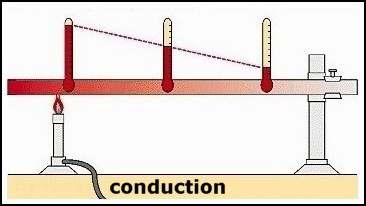
The conduction process applies primarily to heat transmission through solid materials. Metals are bet conductor of heat, whereas non-metals in general are poor conductor or insulator.

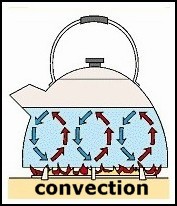
Convention is the process of transmitting heat through a fluid such a liquid or gas. When a container of water is placed on a heat source. at first only the water at the very bottom receive heat by conduction through the container. As the bottom layer of water begins to receive heat, it tends to expand somewhat. This condition causes it to become less dense than the cooler water above it. As A result of this condition, warm water begins to rise the surface, which causes heavier cold water to flow down towards the source of heat. The new bottom layer of water will receive heat and rise to the top. The process is repeated over and over again until boiling occurs.

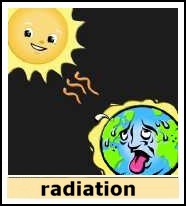
Radiation is a process by which heat is transferred through the motion of waves. A prime example of this is the heat that reaches the earth from the sun. Since the pace between earth and the sun is generally void of molecule except near the earth surface, it heat cannot be transferred by conduction or convention. In effect, heat energy is given off or radiated away from a heat source through infrared rays. Energy of this type moves away from the source in a wave like pattern at the speed of light. An interesting characteristic of radiation is that the air between the heat source and the object. which the waves must pass through, is not heated.
 Convention is the process of transmitting heat through a fluid such a liquid or gas. When a container of water is placed on a heat source. at first only the water at the very bottom receive heat by conduction through the container. As the bottom layer of water begins to receive heat, it tends to expand somewhat. This condition causes it to become less dense than the cooler water above it. As A result of this condition, warm water begins to rise the surface, which causes heavier cold water to flow down towards the source of heat. The new bottom layer of water will receive heat and rise to the top. The process is repeated over and over again until boiling occurs.
 Radiation is a process by which heat is transferred through the motion of waves. A prime example of this is the heat that reaches the earth from the sun. Since the pace between earth and the sun is generally void of molecule except near the earth surface, it heat cannot be transferred by conduction or convention. In effect, heat energy is given off or radiated away from a heat source through infrared rays. Energy of this type moves away from the source in a wave like pattern at the speed of light. An interesting characteristic of radiation is that the air between the heat source and the object. which the waves must pass through, is not heated.